TD-Join
TD-Join: Leveraging Temporal Patterns in Subsequence Joins
This Website presents TD-Join, a novel tool for temporal reasoning on time series. TD-Join enhances time series subsequence joins by integrating Allen’s Algebra, a widely adopted framework for temporal reasoning. Our approach enables users to efficiently identify, query, and interpret temporal relationships over similar time series subsequences.
Video
Code
The code is available at https://github.com/gianlucarossi15/TD-Join/
Time Dependent Matrix Profile
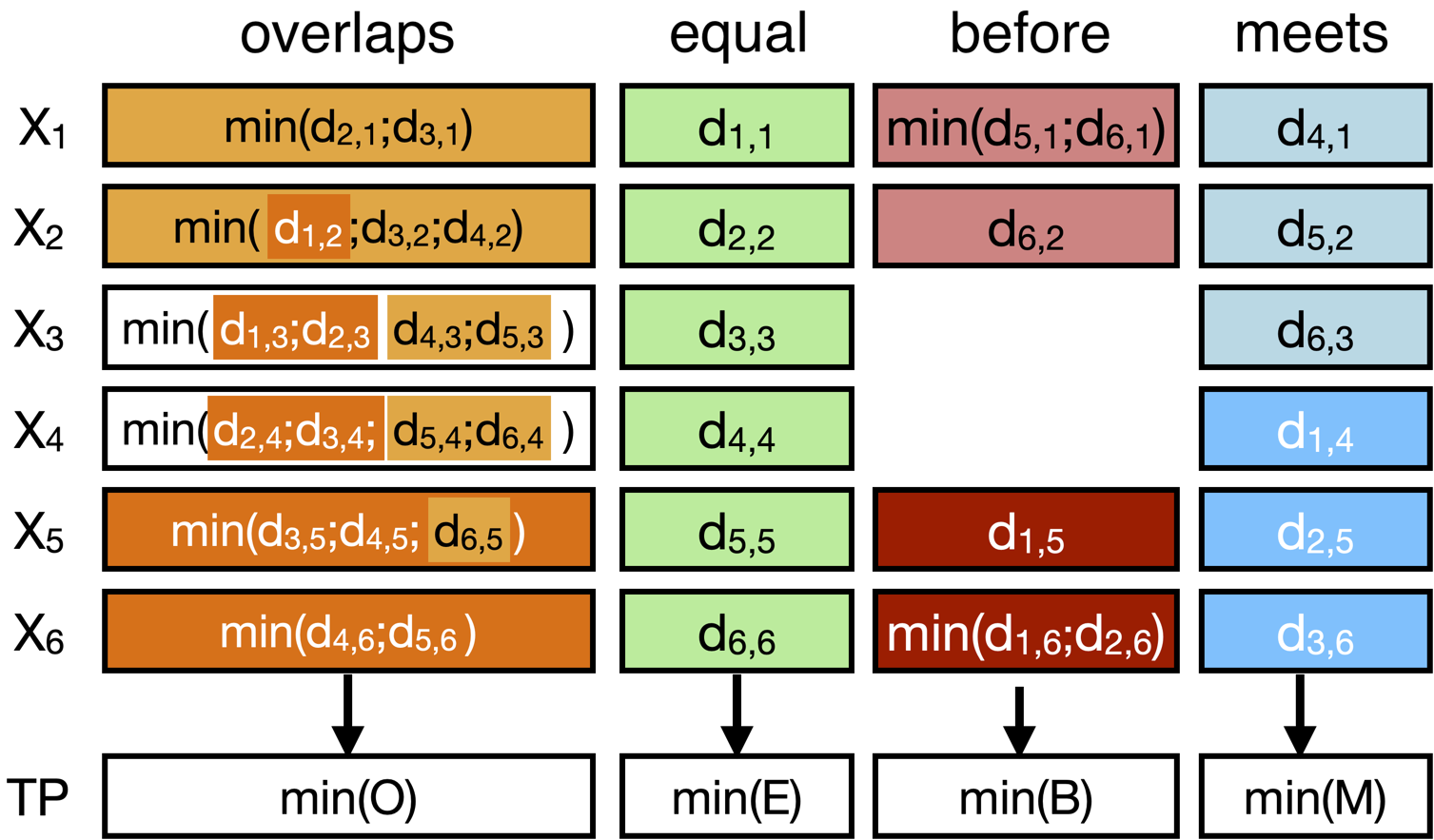 Each column represents the pair of subsequences adhering to the column’s name. By perfoming the minimum operation in each column (for any Allen’s relation) we retain the best pair of subsequences for each Allen’s relation.
Allen’s relation
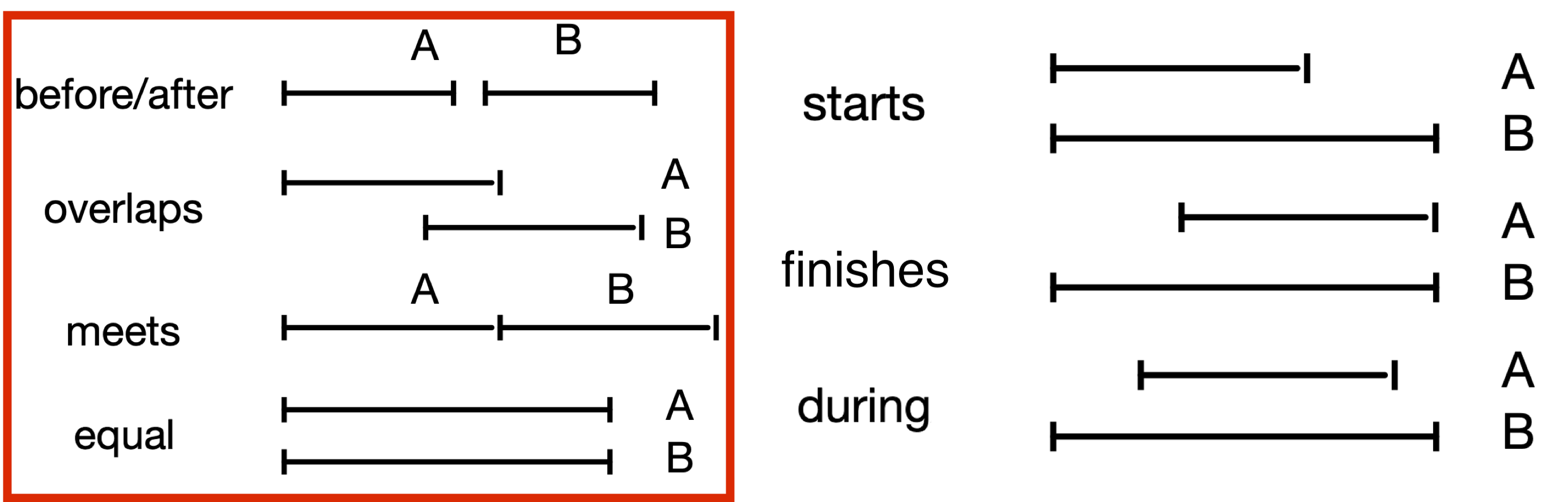
In red there are the Allen’s relations used to construct the Time Dependent Matrix Profile.
Result
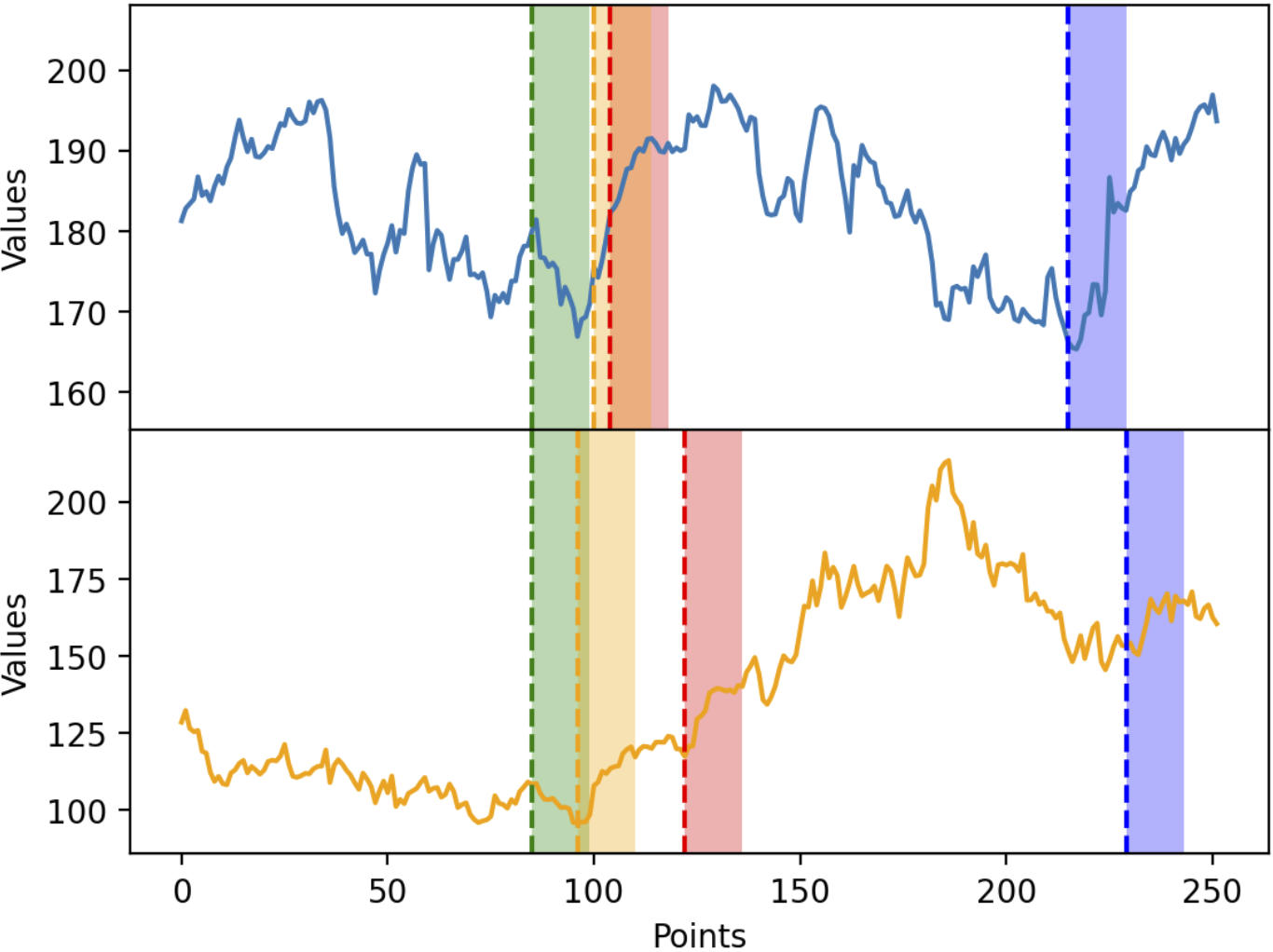
The following Figure shows the results of our TD-join algorithm, where similar subsequences across two time series are highlighted using a consistent color scheme: green for the equal relation, red for before, yellow for overlaps, and blue for meets.
Architecture
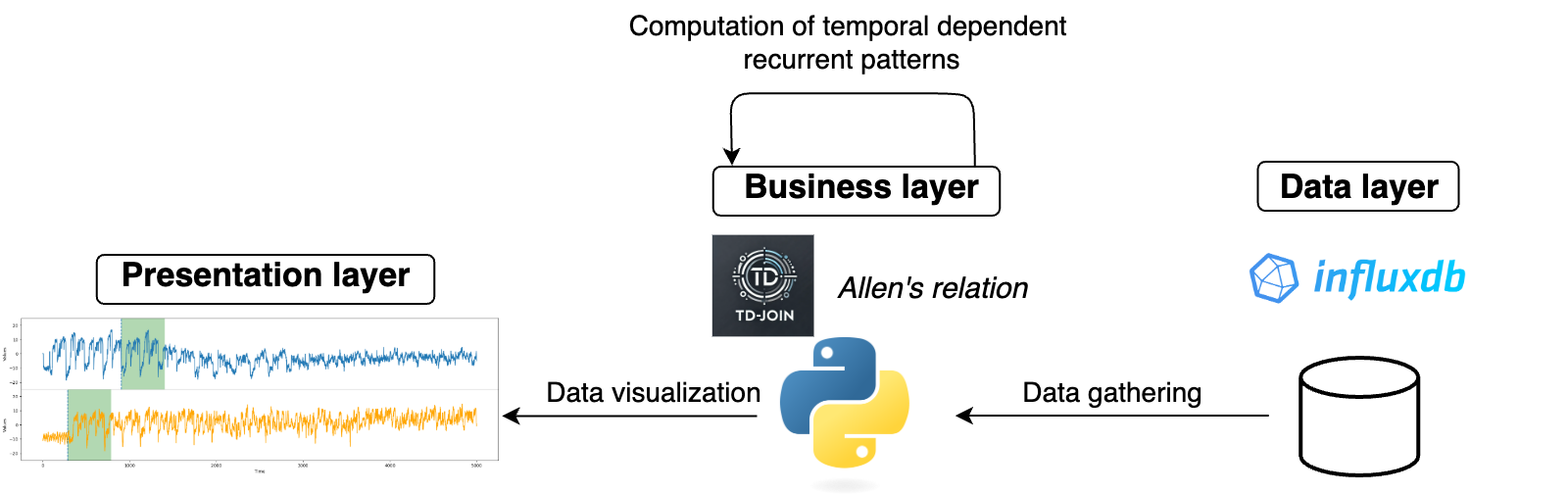
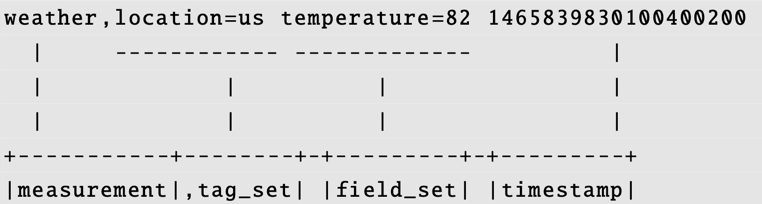
Time series are stored in the time-series database InfluxDB. InfluxDB’s line protocol is a text-based format for storing time-series data. Each entry includes a measurement (collection name), an optional tag set (metadata with key-value pairs), a required field set (data points with key-value pairs), and a timestamp (UNIX format, manual or automatic).
Our TD-Join function, used for performing subsequence joins based on the Time Dependent Matrix Profile along with Allen’s relations, constitutes the business layer.
The presentation layer is dedicated to displaying recurrent temporal patterns.
Publication
The paper is available at https://doi.org/10.1145/3722212.3725137. This work has been accepted at Sigmod 2025 demo track.
Authors
Gianluca Rossi (Lyon 1 University and LIRIS), Riccardo Tommasini (Insa Lyon and LIRIS) and Angela Bonifati (Lyon 1 University, LIRIS and IUF).
Acknowledgements
This work is funded by the French National Research Agency (ANR) under grant number ANR-22-CE92-0025-01.